Best use case
iblai-agent-llm is best used when you need a repeatable AI agent workflow instead of a one-off prompt.
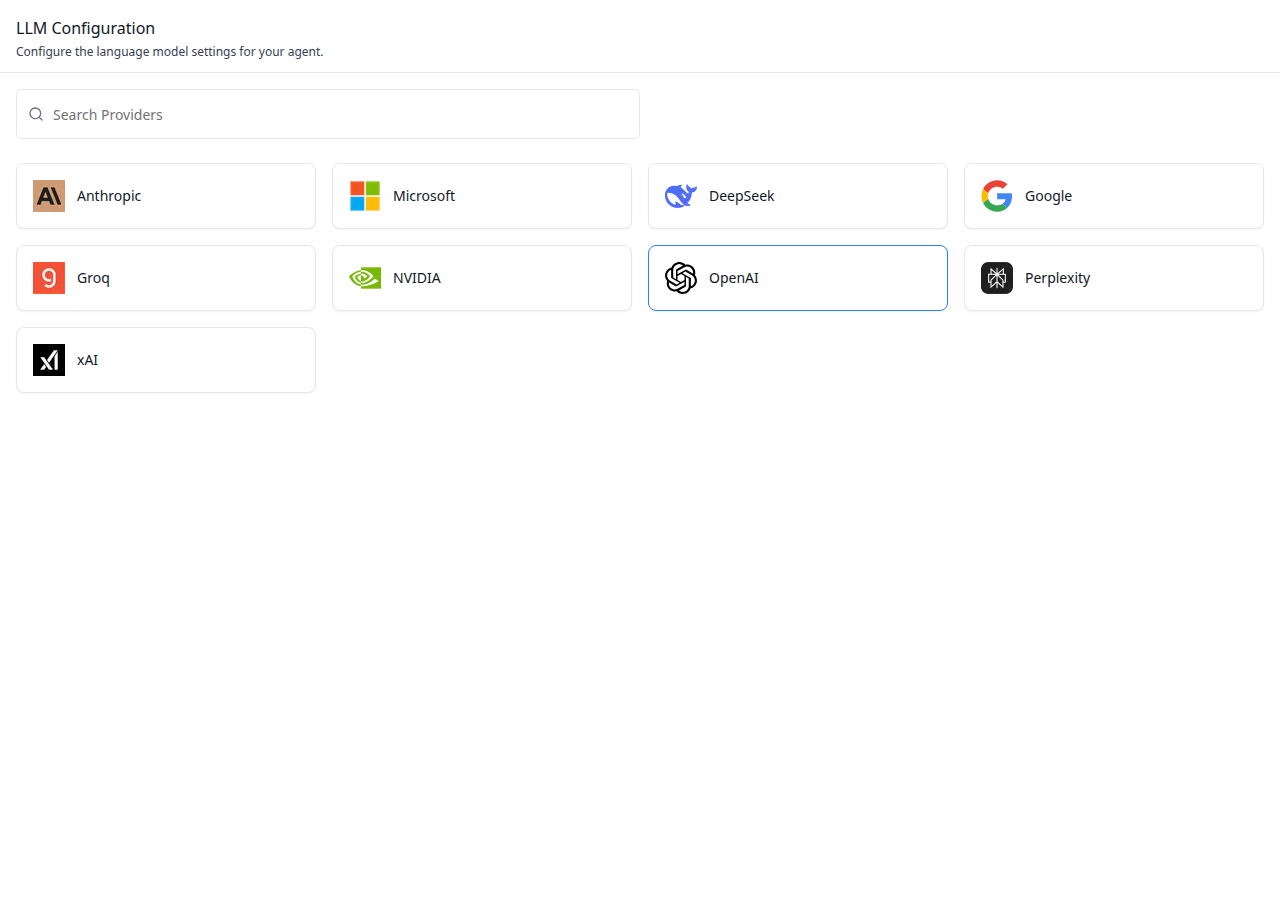
Add the agent LLM tab (model provider selection) to your Next.js app
Teams using iblai-agent-llm should expect a more consistent output, faster repeated execution, less prompt rewriting.
When to use this skill
- You want a reusable workflow that can be run more than once with consistent structure.
When not to use this skill
- You only need a quick one-off answer and do not need a reusable workflow.
- You cannot install or maintain the underlying files, dependencies, or repository context.
Installation
Claude Code / Cursor / Codex
$curl -o ~/.claude/skills/iblai-agent-llm/SKILL.md --create-dirs "https://raw.githubusercontent.com/iblai/vibe/main/skills/iblai-agent-llm/SKILL.md"
Manual Installation
- Download SKILL.md from GitHub
- Place it in
.claude/skills/iblai-agent-llm/SKILL.mdinside your project - Restart your AI agent — it will auto-discover the skill
How iblai-agent-llm Compares
| Feature / Agent | iblai-agent-llm | Standard Approach |
|---|---|---|
| Platform Support | Not specified | Limited / Varies |
| Context Awareness | High | Baseline |
| Installation Complexity | Unknown | N/A |
Frequently Asked Questions
What does this skill do?
Add the agent LLM tab (model provider selection) to your Next.js app
Where can I find the source code?
You can find the source code on GitHub using the link provided at the top of the page.
SKILL.md Source
# /iblai-agent-llm
Add the agent **LLM tab** -- a searchable grid of LLM provider cards with
a modal for selecting specific models within a chosen provider. This is
one tab in the wider agent-settings family. All tabs share the same
`AgentSettingsProvider` wrapper.
Do NOT add custom styles, colors, or CSS overrides to ibl.ai SDK components.
They ship with their own styling. Keep the components as-is.
Do NOT implement dark mode unless the user explicitly asks for it.
When building custom UI around SDK components, use the ibl.ai brand:
- **Primary**: `#0058cc`, **Gradient**: `linear-gradient(135deg, #00b0ef, #0058cc)`
- **Button**: `bg-gradient-to-r from-[#2563EB] to-[#93C5FD] text-white`
- **Font**: System sans-serif stack, **Style**: shadcn/ui new-york variant
- Follow the component hierarchy: use ibl.ai SDK components
(`@iblai/iblai-js`) first, then shadcn/ui for everything else
(`npx shadcn@latest add <component>`). Do NOT write custom components
when an ibl.ai or shadcn equivalent exists. Both share the same
Tailwind theme and render in ibl.ai brand colors automatically.
- Follow [BRAND.md](https://raw.githubusercontent.com/iblai/vibe/refs/heads/main/BRAND.md) for
colors, typography, spacing, and component styles.
You MUST run `/iblai-ops-test` before telling the user the work is ready.
After all work is complete, start a dev server (`pnpm dev`) so the user
can see the result at http://localhost:3000.
`iblai.env` is NOT a `.env.local` replacement — it only holds the 3
shorthand variables (`DOMAIN`, `PLATFORM`, `TOKEN`). Next.js still reads
its runtime env vars from `.env.local`.
Use `pnpm` as the default package manager. Fall back to `npm` if pnpm
is not installed.
> **Common setup (brand, conventions, env files, verification):** see [docs/skill-setup.md](https://raw.githubusercontent.com/iblai/vibe/refs/heads/main/docs/skill-setup.md).
## Prerequisites
- Auth must be set up first (`/iblai-auth`)
- MCP and skills must be set up: `iblai add mcp`
- `AgentSettingsProvider` must wrap the route (see `/iblai-agent-setting`
Step 2 if not already set up)
- Ask the user for a real `mentorId` (agent UUID). Do NOT invent one.
## Step 0: Check for CLI Updates
Before running any `iblai` command, ensure the CLI is up to date.
Run `iblai --version` to check the current version, then upgrade directly:
- pip: `pip install --upgrade iblai-app-cli`
- npm: `npm install -g @iblai/cli@latest`
This is safe to run even if already at the latest version.
## Step 1: Check Environment
Before proceeding, check for an `iblai.env` in the project root. Look for
`PLATFORM`, `DOMAIN`, and `TOKEN` variables. If the file does not exist or
is missing these variables, tell the user:
"You need an `iblai.env` with your platform configuration. Download the
template and fill in your values:
`curl -o iblai.env https://raw.githubusercontent.com/iblai/vibe/refs/heads/main/iblai.env`"
## Step 2: Mount `AgentLLMTab`
`AgentLLMTab` has one required prop: `getLLMProviderDetails`. This maps a
provider name to display info (logo URL, display name). The host app
provides this because logos and display names are host-specific.
```tsx
// app/(app)/agents/[mentorId]/llm/page.tsx
"use client";
import {
AgentLLMTab,
type LLMProviderDetails,
} from "@iblai/iblai-js/web-containers/next";
function getLLMProviderDetails(
providerName: string,
llmName?: string,
): LLMProviderDetails {
const providers: Record<string, LLMProviderDetails> = {
openai: { name: "OpenAI", logo: "/logos/openai.svg" },
anthropic: { name: "Anthropic", logo: "/logos/anthropic.svg" },
google: { name: "Google", logo: "/logos/google.svg" },
};
return (
providers[providerName] ?? {
name: providerName,
logo: "/logos/default.svg",
}
);
}
export default function AgentLLMPage() {
return (
<div className="flex h-full flex-col bg-white">
<AgentLLMTab getLLMProviderDetails={getLLMProviderDetails} />
</div>
);
}
```
## Step 3: Customize Labels (Optional)
```tsx
import { AgentLLMTab } from "@iblai/iblai-js/web-containers/next";
<AgentLLMTab
getLLMProviderDetails={getLLMProviderDetails}
labels={{
header: { title: "Model configuration" },
}}
/>;
```
## Step 4: Use MCP Tools for Customization
```
get_component_info("AgentLLMTab")
get_component_info("AgentSettingsProvider")
```
## `<AgentLLMTab>` Props
Import from `@iblai/iblai-js/web-containers/next`.
| Prop | Type | Required | Description |
|------|------|----------|-------------|
| `getLLMProviderDetails` | `(providerName: string, llmName?: string) => LLMProviderDetails` | Yes | Maps provider name to display info (logo, display name) |
| `labels` | `DeepPartial<LLMTabLabels>` | No | Override user-visible strings |
| `showConfigurationHeader` | `boolean` | No | Show/hide the configuration header |
## Related Exports
From `@iblai/iblai-js/web-containers/next`:
- `AGENT_LLM_TAB_LABELS` -- the default agent-facing label bundle.
- `LLMTabLabels` -- type for the full label bundle.
- `LLMProviderDetails` -- type for the return value of `getLLMProviderDetails`.
- `LLMProvider`, `Provider` -- types for provider data structures.
## Step 5: Verify
Run `/iblai-ops-test` before telling the user the work is ready:
1. `pnpm build` -- must pass with zero errors
2. `pnpm test` -- vitest must pass
3. Start dev server and touch test:
```bash
pnpm dev &
npx playwright screenshot http://localhost:3000/agents/<id>/llm /tmp/agent-llm.png
```
## Important Notes
- **Redux store**: Must include `mentorReducer` and `mentorMiddleware`
- **`initializeDataLayer()`**: 5 args (v1.2+)
- **`@reduxjs/toolkit`**: Deduplicated via webpack aliases in `next.config.ts`
- **Peer deps**: `sonner` and `@iblai/iblai-web-mentor` must be installed
(`pnpm add sonner @iblai/iblai-web-mentor`)
- **Shared provider**: `AgentSettingsProvider` must wrap the route at a
layout level. See `/iblai-agent-setting` Step 2 for the full snippet.
- **Required prop**: `getLLMProviderDetails` is host-provided because
logos and display names vary per deployment.
- **Brand guidelines**: [BRAND.md](https://raw.githubusercontent.com/iblai/vibe/refs/heads/main/BRAND.md)Related Skills
We are still matching the closest adjacent skills for this page. In the meantime, continue through the full directory.